
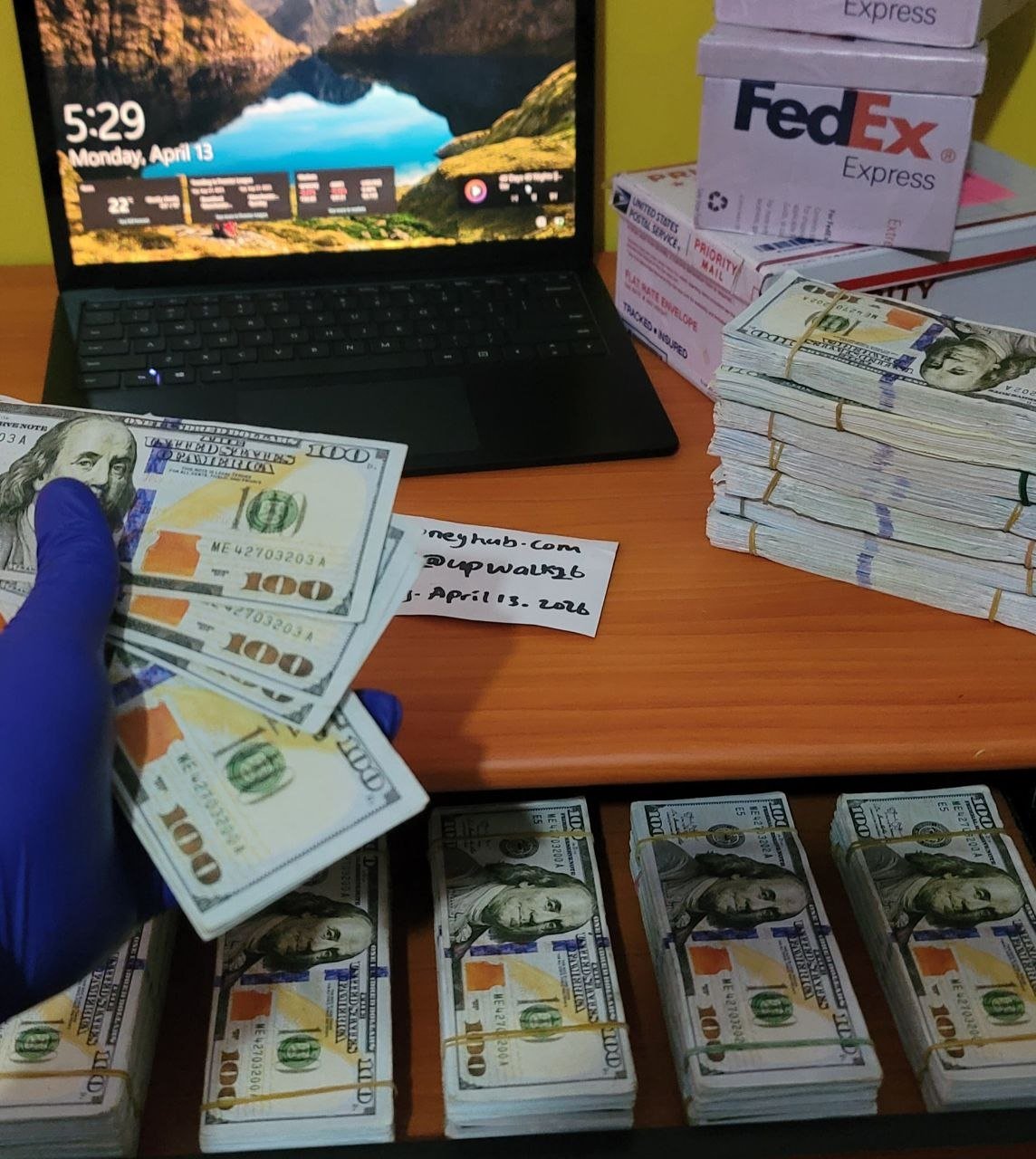

Know Which $100 Bill Is Real
Fake $100 Bills is a real issue in every country, but the United States actually experiences relatively small financial losses from it compared with the size of its economy and money supply.
To understand how much the U.S. has “lost,” you have to look at several things: how much counterfeit currency exists, how much is successfully pass in transactions, and who absorbs the losses. Below is a more detail explanation.

1. How much counterfeit U.S. money exists
The most reliable estimates come from the Federal Reserve System and the United States Secret Service, the two agencies that track counterfeit currency.
- Research published by the Federal Reserve estimates that about $15–$30 million in counterfeit U.S. currency is circulating at any given time.
- This corresponds to roughly 1 counterfeit bill for every 40,000–80,000 genuine bills.
- Other Treasury estimates place the total possible range between $70 million and $200 million worldwide, depending on how it is measured.
To put that in perspective:
- Total U.S. currency in circulation is over $2 trillion.
- Even the highest estimates of counterfeit money represent far less than 0.01% of all U.S. cash.
So the actual amount of fake currency relative to real money is extremely small.
2. How much money is “lost” each year
Losses happen when counterfeit bills are successfully used in transactions before being detected.
Historically:
- In some years, $50–$100+ million in counterfeit bills are passed annually in the United States.
- For example, a Federal Reserve analysis recorded $56.2 million in counterfeit currency passed in one year (2005) inside the U.S. alone.
However, this does not mean the U.S. government loses all that money.
Instead:
- When a counterfeit bill is discovered, it is removed from circulation and destroyed.
- The person or business holding it absorbs the loss, because counterfeit currency cannot be exchanged for real money.
3. Who actually bears the financial loss
The losses from counterfeit currency are distributed among several groups.
1. Businesses
Retailers, gas stations, and restaurants are the most common victims.
Example:
- A store accepts a fake $100 bill.
- Later the bank detects it as counterfeit.
- The bank confiscates the bill, and the store loses $100.
2. Individuals
People can receive fake cash:
- In private sales
- From scams
- In change during transactions
Once detected, the bill is confiscated and no reimbursement is provided.
3. Banks
Banks sometimes absorb losses if counterfeit bills are detected after deposits.
4. Government costs
The U.S. government also spends money on:
- Investigation
- Currency redesign
- Anti-counterfeiting technology
But these costs are relatively small compared with the national budget.
Fake $100 Bill In Circulation Than $20 Bills
4. Which bills are counterfeited the most
Different denominations attract counterfeiters for different reasons.
Most counterfeited in the U.S.:
- 💵 $20 bills (most common in everyday transactions)
Often counterfeited internationally:
- 💵 $100 bills (more profitable overseas)
The reason criminals target these bills:
- $20 → easy to pass without suspicion
- $100 → high profit per note
5. Where counterfeit money comes from
Counterfeit U.S. currency is produced both domestically and internationally.
Historically, many major operations have been found in:
- South America (especially Peru and Colombia)
- East Asia
- Eastern Europe
In some investigations, the United States Secret Service has seized millions of dollars in counterfeit currency during a single operation.
Because the U.S. dollar is used worldwide, it is the most counterfeited currency globally.
6. How the U.S. keeps counterfeiting low
The United States constantly upgrades its currency security features.
Modern U.S. bills include:
- Security threads
- Color-shifting ink
- Watermarks
- Microprinting
- 3-D security ribbons (on newer $100 bills)
These features make high-quality counterfeiting extremely difficult.
7. Historical comparison
Interestingly, counterfeiting used to be much worse in the 1800s.
Before centralized currency design:
- Thousands of different banknotes existed.
- Some estimates say up to one-third of circulating currency was counterfeit in the 1860s.
This problem is one of the main reasons the United States Secret Service exist since in 1865.
8. Overall economic impact
Compared to the scale of the U.S. economy:
- Total counterfeit circulation: tens of millions
- U.S. currency circulation: trillions
- U.S. GDP: $27+ trillion
So counterfeit money represents an extremely small economic loss.
Most experts consider U.S. currency one of the most secure currencies in the world.